Coach, Minibus, Sprinter Van or Limo — Choosing the Right Vehicle Class for Your Event

Two groups of the same size can need completely different vehicles. Fourteen executives travelling to a client dinner and fourteen teenagers travelling to a tournament have the same headcount and almost nothing else in common.
Vehicle class is about the character of the occasion as much as the number of seats. Here is how the options actually differ and which suits what.
The Sprinter Van
Typically seating twelve to fifteen, the Sprinter van is the most manoeuvrable option in the charter fleet. It reaches places larger vehicles cannot — narrow streets, underground parking, rural driveways, tight venue entrances.
It suits executive transfers, small corporate groups, airport runs, wedding party transport and family travel. The trade-off is cargo capacity, which is limited once the vehicle is at full passenger load, and the absence of an onboard washroom.
The Minibus or Mid-Size Coach
Covering roughly twenty to thirty-five passengers, this class fills the gap between a van and a full coach. It is the most commonly under-considered option, largely because organisers default to thinking in terms of vans or big buses.
It works well for medium corporate groups, school and youth trips, community outings and venue shuttles. Storage varies considerably between vehicles in this class — some have undercarriage bays, many do not — so luggage capacity needs confirming specifically rather than assumed.
The Full-Size Motorcoach
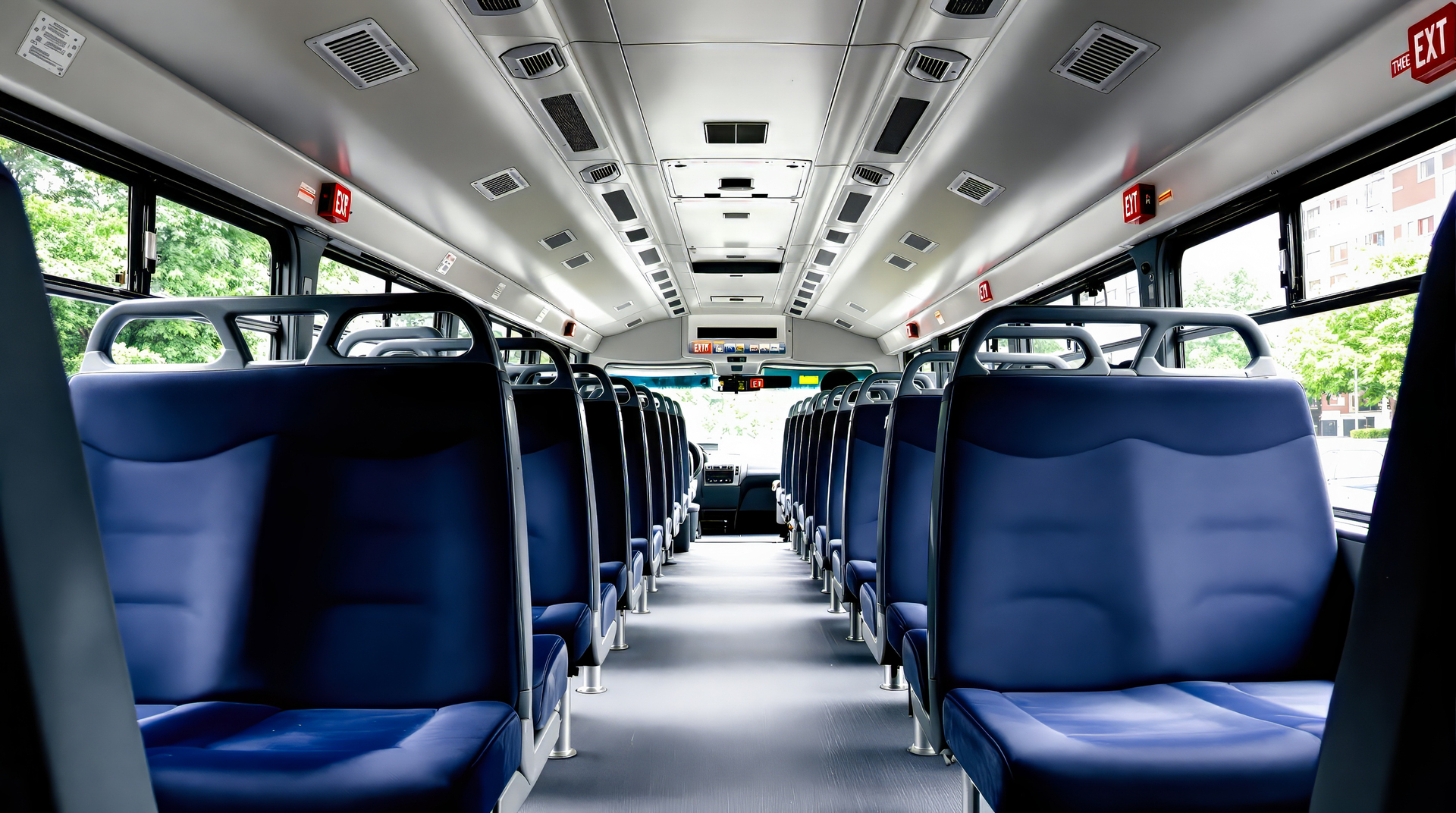
Forty-five to fifty-six passengers, generous undercarriage storage, reclining seats, climate control and usually an onboard washroom. This is the vehicle designed for distance.
It is the right answer for long-distance travel, large groups, equipment-heavy teams and any journey where comfort over several hours matters. The limitation is access — a coach cannot reach every venue, and rural properties, older cemeteries, some downtown streets and many underground facilities are simply out of reach.
The School Bus
Economical, high capacity and purpose-built for student transport. For local school trips, camp runs and short youth group journeys it remains the most cost-effective option available.
The constraints are real for other uses: bench seating, no recline, limited luggage space and generally no air conditioning. For a forty-minute run it is fine. For a three-hour drive with adults in July it is not.
The Limousine and Party Bus Category
These are a different product serving a different purpose. They prioritise the experience during travel — the vehicle is part of the event rather than a means of reaching it.
They suit occasions where the journey is meant to be memorable in itself. They are less suited to practical transportation of larger groups over distance, where seating capacity, luggage space and comfort over hours matter more than atmosphere.
Matching Vehicle to Occasion
- Executive and client transport — Sprinter van, for discretion and access
- Wedding guest shuttles — coach or mid-size, run as a loop
- Sports teams with equipment — full coach, driven by cargo not headcount
- School field trips — school bus locally, coach for longer distances
- Long-distance adult groups — full coach with washroom
- Rural venue access — mid-size or multiple vans
- Airport transfers — sized to luggage, not to passengers
The Questions That Actually Decide It
Four questions settle most vehicle decisions. How far is the journey? How much luggage or equipment is coming? Can the destination physically accommodate a large vehicle? And does anyone need accessible boarding?
Notice that passenger count is not among them. Headcount sets the minimum capacity; these four determine the class.
When Two Smaller Beats One Larger
Splitting a group across two vehicles costs more but buys flexibility. Different pickup points, different return times, access to venues a coach cannot reach, and resilience if one vehicle has a problem.
For rural weddings and multi-site events, two mid-size vehicles frequently produce a better day than one large one.
Accessible Vehicles Are a Separate Category
Vehicles equipped with lifts or ramps and securement positions exist across most vehicle classes, but they are specific units rather than a standard feature, and they are in limited supply.
If any passenger uses a mobility device, this needs raising in the first conversation rather than added later. It affects which vehicle can be assigned, how much lead time is needed, and how much boarding time the schedule should allow. Late notice on accessibility is the hardest kind of late notice to resolve, because the constraint is fleet availability rather than willingness.
Getting the Recommendation
Describe the occasion rather than requesting a vehicle type. Tell the operator who is travelling, how far, with what, and to where — and let the recommendation come back.
Neios Transport operates Sprinter vans, mid-size buses, school buses and full-size coaches across Toronto and Ontario. Call (416) 884-1141 or visit neiostransport.ca for a recommendation.
Keep planning
-
 School trips
Keeping Children Happy on a Long Bus Journey — A Guide for Schools, Camps and Families
Practical advice for keeping children comfortable on long bus journeys. Seating, rest stops, activities, motion…
Read guide -
 Weddings & events
New Year's Eve Group Transportation Toronto — Safe, Fixed-Price, Stress-Free
New Year's Eve in Toronto means surge pricing and no rideshares at midnight. A charter bus gives your group a fixed…
Read guide -
 School trips
Sprinter Van, School Bus or Coach? How to Choose the Right Bus Size for Your Group
Sprinter van, school bus or coach? Compare capacity, comfort and trip type to choose the right size charter bus for…
Read guide